
Mutual Fund inflows in FY25 have already reached two-thirds of the total inflows seen in the entire FY24, with net inflows standing at Rs 1.3 trillion.

SEBI has published data showing that more than 90 per cent of investors lose money in futures and options, explains Harsh Roongta.


If you redeem your investments when prices have fallen sharply, you will be selling at low prices and may make a permanent loss. On the other hand, if you remain patient and remain invested, you give your investment the time to recover, says Dwaipayan Bose

Stopping SIPs during a downturn undermines the benefit of rupee-cost averaging.

The ultra-rich invest differently -- embracing growth, compounding, and long-term clarity to build wealth with purpose and discipline, explains Ramalingam Kalirajan.

Paper gold saves your investments from volatility, and you from hassles that come with the physical form. The chance of good returns gives that extra shine.

Lord Ganesha's teachings offer valuable insights for investors in the Indian stock market. By thinking big, working consistently, starting early, and approaching investing with a rational mindset, investors can increase their chances of achieving their financial goals.

Improvement in financial savings channelised massive inflows into the equities market through the mutual fund route.

Majority of equity linked savings schemes as well as mid and small-cap funds outperformed their respective benchmark indices over a five-year period ended December 2015.

Many investors want to exit equities now and re-enter when they begin to rise. Such timing is difficult to pull off.

The impending merger between Housing Development Finance Corporation (HDFC) with HDFC Bank may create challenges for large-cap fund managers, most of whom are already grappling to match the returns generated by their benchmarks. The combined weight following the merger in the benchmark Sensex and Nifty 50 indices is likely to be much higher than permissible limits for active mutual fund (MF) schemes. This could have a bearing on the performance of large-cap funds if HDFC Bank shares outperform the markets, as the schemes will be forced to remain underweight on the stock to adhere to the single-stock cap.

DIIs owned equities worth Rs 73.5 trillion, just 1.9 per cent less than FPIs. This marks a significant change from a decade ago.
Now that the gold exchange traded funds (GETFs) are being sold in the market, let's look at a few things to understand them better.

Zomato on Monday became the first new-age company to join the prestigious 30-share benchmark Sensex, replacing JSW Steel. This milestone marks a significant achievement not only for Zomato but also for the Indian startup ecosystem, which is increasingly making its presence felt in the $5.2 trillion listed ecosystem.

Data from Value Research analysed on five-year, three-year and one-year performances of active equity schemes to pick the best performers in popular scheme categories.

Midcap stocks Hero MotoCorp, Zydus Lifesciences, JSW Energy, NHPC, Bharat Heavy Electricals, Bosch, and Samvardhana Motherson are expected to earn upgrades.

Mutual funds' average cash holdings in equity schemes topped 6 per cent in February as fund managers went slow on deployment of new inflows on expectations of better buying opportunities amid uncertainties in the market.

'The Bhashini Mission has delivered a working technology at large scale, which is as good as or better than the one with MNC tech giants.'

The MF investor count, which stood at around 38 million in April 2023, has surged by 19 per cent in the past year.
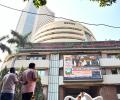
'BSE has facilitated nearly Rs 35 trillion in capital raising across multiple segments.'

'Market corrections are a natural part of investing, so it's essential to remain focused on long-term financial goals.'

'He will be remembered more for what he did as finance minister -- as someone who functioned well when the political fallout was taken care of.'

These funds give the wealthy an option to invest in strategies that other equity products like mutual funds and portfolio management services cannot, says Nishant Agarwal.

India's largest asset manager SBI Funds Management on Tuesday said they are negative on equities from a shorter-term perspective as valuations have risen above the comfort zone. "We are not positive on equities. We think valuations are expensive. "The market has gone up a lot more than the earnings have grown," said R Srinivasan, Chief Investment Officer (CIO) - Equity at SBI Mutual Fund, at the launch of asset management companies' (AMC) yearly report on the market outlook.

rediffGURU Ramalingam Kalirajan answers your personal finance queries.
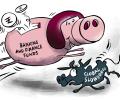
Invest only if you wish to go overweight on the sector.

'Your decisions should not be driven by your view on the market, but by your objectives, risk appetite, and time horizon.'

'Funds based on this theme offer socially conscious investors an option to invest in a portfolio that is aligned to their beliefs.'

Indian investors can now trade in an international index as the Hang Seng Benchmark Exchange Traded Fund (Hang Seng BeES) will be available on the National Stock Exchange from Thursday.

Domestic bourse BSE has approved the acquisition of a 50 per cent stake in index provider Asia Index (AIPL) from equal joint venture partner S&P Dow Jones (SPDJ) Indices for Rs 30 crore. AIPL, the index provider, is responsible for compiling and maintaining the widely followed Sensex, Bankex, and other indices. Passive funds with assets of nearly Rs 2 trillion are benchmarked with indices provided by AIPL.
With the listing of Reliance gold ETF on the National Stock Exchange (NSE) on Wednesday, four fund houses (Benchmark, UTI Mutual Fund and Kotak Mutual Fund being the other three) currently offer gold ETFs to Indian investors.

'Those satisfied with returns and not expecting further rally could be booking profits and also stopping SIPs.'

Actively-managed large-cap mutual fund (MF) schemes have managed to regain some lost sheen this year after faring poorly in the 2022 calendar year (CY22). At the end of the first six months (H1) of CY23, 78 per cent of the active large-cap schemes were ahead of the Nifty50 index funds as against just 26 per cent in 2022. When compared to the Sensex index funds, 61 per cent active funds have delivered better returns, shows an analysis of Value Research data.

Among the 30 Sensex firms, Asian Paints, Infosys, JSW Steel, UltraTech Cement, Power Grid, Larsen & Toubro, HCL Technologies and Tata Steel were the biggest laggards. Tata Motors, HDFC Bank, Bharti Airtel, ITC, IndusInd Bank and Axis Bank were the gainers.

Domestic institutional investors pumped Rs 2.3 trillion into equities during H1 CY24. Of this, mutual funds contributed 80%.

A day after his appointment as the 26th governor of the Reserve Bank of India (RBI), outgoing Revenue Secretary Sanjay Malhotra on Tuesday said one must understand the economic landscape and do what was best for the economy. "Let me first go, join, understand the turf ... Here it is a different role," Malhotra said, speaking to reporters in front of North Block.
The market for Shariah funds is set to grow with Benchmark Mutual Fund launching the first-ever Shariah Benchmark Exchange-traded scheme in India. It's an open-ended listed index scheme.

Actively managed debt funds with the flexibility to go long on duration made a strong comeback on the returns chart in 2023, thanks to softening bond yields. The average one-year returns of floater, long-duration, gilt, and dynamic bond funds, which ranged between 2.3 per cent and 4.5 per cent at the end of 2022, now stand at over 7.2 per cent, with some schemes delivering over 8.5 per cent, according to data from Value Research. Debt fund returns are inversely related to yields of underlying investments, meaning a decline in yields is positive for funds.
 © 2026 Rediff.com - Advertise with us - Disclaimer - Privacy Policy - Sitemap - Feedback - About us - Terms of use - Grievances